Evidence Base
The Evidence and Gap Map (EGM) focuses on evaluating the effectiveness of strategies for preventing violent conflict and atrocities. It provides a systematic framework connecting intervention strategies with measurable outcomes like reduced violence and improved social cohesion

Cells With Impact Evaluation and Systematic review
4.1.1 Policing and public security
4.1.1(1)
|
The effect of Policing & Public Security on Diplomatic Relations & Peaceful Dispute Resolution Effect: Negative (While community mediation is viewed positively and holds significant potential, the perception of police mediation is documented negatively for addressing conflict, diplomatic relations & peaceful dispute resolutions in East Asia & Pacific countries) Confidence in study findings: Low (one study, low confidence) |
Summary
Indonesian men often perceive the police as ineffective and potentially corrupt, leading to widespread distrust. In contrast, community mediation is viewed positively and holds significant potential for conflict resolution, diplomatic relations, and peacebuilding in East Asia and Pacific countries. However, trust in mediation is largely limited to religious leaders. Suspicion of mediation interventions and other measures that are tied to the authority of the state means that the promise of service-oriented policing reforms may not be effectively implemented.
Summary Table
INT.CAT | OUT.CAT | NO. OF STUDIES | REGION | EFFECT SIZE | CONFIDENCE |
SAFE ENIRONMENTS | |||||
Policing and Public secuirty | nature and scale of violence and atrocities | 6 | Asia, Latin America, Africa, Middle East | No effect (g=0.007) | Low (6 studies with 20 effect sizes) |
Policing and Public secuirty | feelings of trust and acceptance of diversity | 1 | Latin America, Africa, Asia | Small effect (g=0.084) | Low (1 study with 1 effect size) |
Policing and Public secuirty | government performance | 5 | Asia, Latin America, Africa | Adverse effect (g=-0.004) | Low (5 studies with 21 effect sizes) |
Policing and Public secuirty | presence and quality of social safety nets | 2 | Middle East, Asia, Africa, Global | Small effect (g=0.045) | Low (2 studies with 4 effect sizes) |
Policing and Public secuirty | physical security | 3 | Asia, Latin America, Africa | Large effect (g=0.453) | Low (3 studies with 22 effect sizes) |
Policing and Public secuirty | political security | 1 | Middle East | Small effect (g=0.034) | Medium (1 study with 2 effect sizes) |
Military Operations | Diplomatic relations & Peaceful dispute resolution | 2 | Global | Moderate effect (g = 0.107) | Low confidence |
To understand strategies for preventing violence and atrocities, the Foreign, Commonwealth& Development Office (FCDO) initiated a project to gather evidence on “what works” in this area. In a previous project, we developed an Evidence and Gap Map (EGM) that included studies examining various interventions aimed at preventing violence and atrocities. This EGM is structured as a matrix, with rows representing interventions and columns representing outcomes. Each study included in the EGM assesses the impact of at least one intervention on at least one outcome. Therefore, a study analyzing the effect of Intervention X on Outcome Y would be placed in cell XY; if the study evaluates multiple interventions and/or outcomes, it appears in all relevant cells.The EGM shows where there is such evidence and where there isn’t; it does not show what the evidence says. This guidebook, produced as part of the extension project, summarizes the evidence presented in the EGM. Given the diverse methodologies of the included studies, we have established specific guidelines for cell-wise summaries:
- If a cell contains only reviews, the summary is based on those reviews.
- If a cell contains both reviews and qualitative studies, the summary is based on the reviews.
- If a cell contains both reviews and quantitative studies, both types are summarized.
- If a cell contains only quantitative studies, the summary focuses on those studies.
- If a cell contains only qualitative studies, the summary is based on those studies.
Our aim is to help funders, policymakers, practitioners and others to make evidence-informed decisions, and also to find easily the evidence relevant to the decisions they need to make.
We have defined criteria for including and excluding studies, employing an intervention-outcome framework. In this extension project, we have combined certain intervention and outcome categories to develop a simplified evidence gap map (EGM), as detailed in Annexure 1. The current map has eligibility criteria based on the population, intervention, comparator, outcome, and study Design (PICOS) framework. While we provide a brief overview of these criteria here, comprehensive details are available in the published report.
Types of settings
The included studies evaluating the effectiveness of the interventions in settings where there was ongoing violence (active), where the violence had abated but was seen as at risk of restarting (dormant); and where there were risks that violence on a larger scale would break out (latent).
Types of Populations
Eligible populations were all those living in L&MICs, we excluded studies of programmes and policies that predominantly affected or only reported effects for populations in high income countries (HICs). We included studies set in both fragile and non-fragile contexts, acknowledging that violent conflict and atrocities can have arisen in stable contexts
Overall findings in the Guidebook: What that evidence says
Cells with only Quantitative studies, cells with quantitative studies, and systematic review/ qualitative studies
The distribution of studies across cells reveals significant evidence concentration in a few areas while highlighting substantial gaps in others. Three cells contain more than 20 studies, including one examining DDR’s effects on the nature and scale of violence or atrocities and two related to sanctions—one on violence and atrocities and the other on economic security. Seven cells have more than 10 studies, covering topics such as military operations, diplomatic relations, intergroup relations, social funds, foundational state design and training, and job creation. Additionally, one cell contains exactly 10 studies, focusing on the effects of social funds/community-driven development, reconstruction intervention on the feeling of trust. 31 cells have fewer than 10 studies, 13 contain exactly five studies, 87 cells have fewer than five studies. However, 81 cells contain only one study and the majority of cells (168 cells) have fewer than five studies, highlighting significant evidence gaps in these areas.
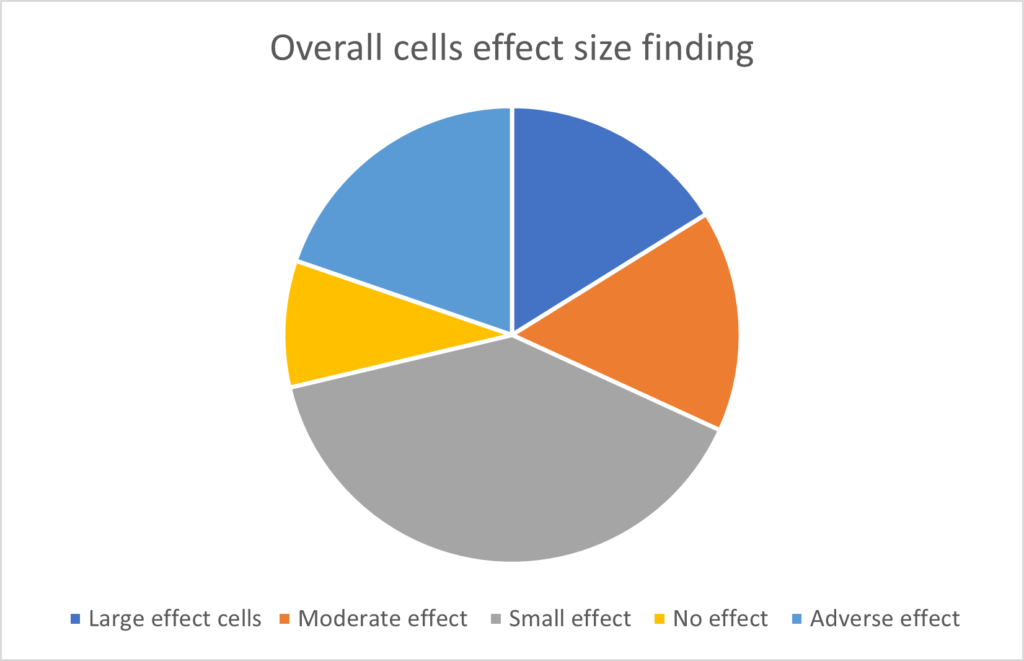
Among the total cells, there were around 16% with large effect cells; 15% with moderate effect cells; 39% with small effect cells; 8% with no effect cells and 19% with adverse effect cells.
Row Level summaries:
Among the 27 subcategories across six main categories, we identified key areas for row-level summaries.
Safe Environment- Disarmament, Demobilization, and Reintegration (DDR)
Row summary
Disarmament, demobilization and reintegration of ex-combatants and peace support/keeping operations
Peacekeeping is most effective in establishing stability which allows delivery of services, including a functioning justice system, which usually not possible during conflict. Access to justice, rights and public services is the only outcome with a large positive effect.
Peacekeeping also supports a achieving a peaceful dispute resolution – though this depends on providing mediation together with peacekeeping. Diplomatic relations & peaceful dispute resolution and transitions of power both have moderate positive effects.
Table 4 – Effect sizes from Disarmament, Demobilization, and Reintegration (DDR)
Outcome Category | Effect size | No. of studies | No. of effect sizes |
Access to justice, rights and public services | 0.351 | 1 | 4 |
Diplomatic relations & peaceful dispute resolution | 0.160 | 8 | 32 |
Transitions of power | 0.138 | 2 | 6 |
Sense of Belonging | 0.094 | 1 | 8 |
Social norms regarding violence and atrocities | 0.094 | 3 | 7 |
Educational security | 0.078 | 2 | 11 |
Food security and nutrition | 0.070 | 1 | 6 |
Economic security | 0.061 | 7 | 33 |
Intermediate social cohesion outcomes | 0.060 | 1 | 3 |
Social cohesion | 0.060 | 1 | 6 |
Nature and scale of violence or atrocities | 0.058 | 9 | 54 |
Feelings of trust and acceptance of diversity | 0.041 | 2 | 17 |
Physical security | 0.034 | 2 | 6 |
Civic participation | 0.024 | 2 | 5 |
Government performance | -0.066 | 3 | 12 |
Sexual and gender- based violence | -0.295 | 1 | 2 |
Note: A positive sign indicates an improvement, e.g. less violence, and a negative sign an adverse effect.